Inside Police Stations

Police Culture
When a woman enters a police station seeking help for domestic violence, the expectation—both legally and socially—is that she will receive protection, safety planning, and an impartial investigation. However, when she encounters a perpetrator within the police system itself, or a culture that tolerates misogyny or minimises violence against women, the experience and outcomes can be profoundly different and extremely traumatising. The Bystander effect shows that the rest turn a blind eye.
"When the culture is poor, it erodes trust"
Independent Cultural Review into the NSW Police Force-2.pdf
This report shows that the women in policing stood by and did nothing to protect themselves or to protect the wives of the police officers.
They themselves watched as women were abused by the system, by their partners and controled by the 'blue boys club'.
It states in this report on page 8 that;
"without exception EVERY women came forward to speak with us describing experiences or OBSERVATIONS of overt or COVERT harrassment, undermining and belittlement".
So who controlled the environment? - The blue boys club
So can we trust them doing an internal review of their culture independantly???
I don't think so!
So maybe this needs to be referred to the ICAC?
This needs transparency with external independant overview by experts in field psychology, social work, human resources with the profound nuance of the lived experienced included. As every committie has two pannels nowadays. One of experts and the other of lived experienced.
It states on page 9 of the report there is a "resistance to change and hostility to outside expertise". This is concerning since Kristen Hilton is considered an outsider and this is her report.
A special thank you to Karen Webb for starting this review

All it takes is one bad apple to spoil the barrel
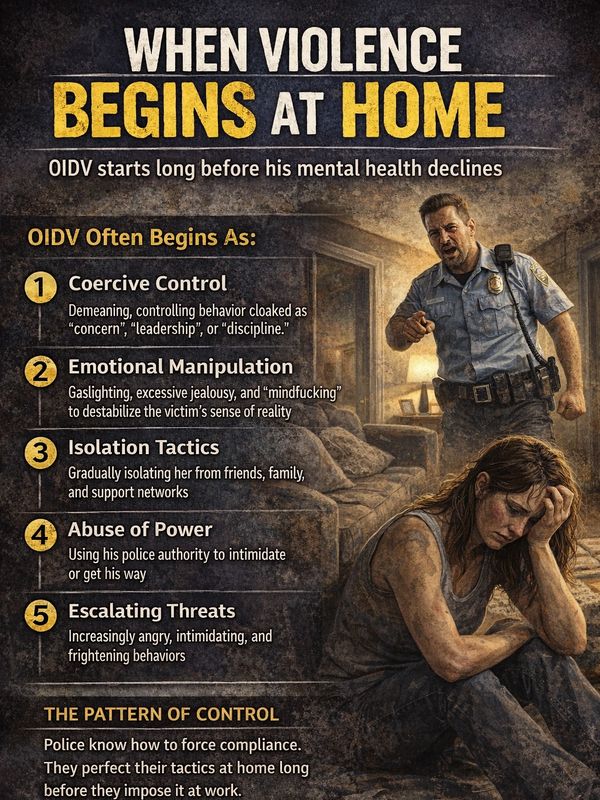
Officer‑Involved Domestic Violence in Police Families
Domestic violence in police families can look different, behave differently, and escalate differently because the perpetrator may have authority, credibility, access, and system knowledge that most perpetrators do not.For health professionals, this matters. Victim‑survivors may present with heightened fear, complex trauma responses, and barriers to help‑seeking that are shaped by the perpetrator’s role and connections. Recognising these unique signs can be critical to safety.(This information is general in nature and not legal advice. If someone is in immediate danger, call 000.)
How OIDV can present differently
When the perpetrator is a police officer, the abuse may be reinforced by:
- Professional authority and credibility (being believed by default, being seen as “the good one”)
- Knowledge of the justice system (how complaints are assessed, how evidence is interpreted, how narratives are formed)
- Access to weapons or police equipment (including the presence of firearms in the home)
- Access to sensitive information and networks (colleagues, systems, local relationships)
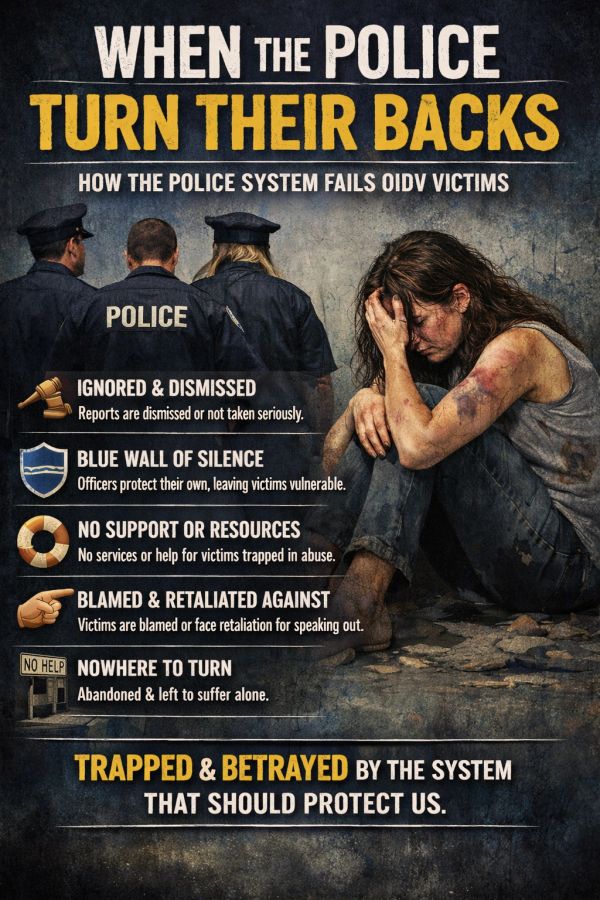
- Institutional loyalty and “code of silence” dynamics, which can increase a victim’s fear of being dismissed, blamed, or targeted
Not all police officers use their role to harm a partner—but when OIDV occurs, these factors can significantly increase risk and isolation.
Forms of abuse in OIDV
OIDV can take many forms. The behaviours below are not exhaustive, but they are commonly reported patterns.
1) Physical violence and physical intimidation
This may include:
- Using force to restrain, immobilise, or block escape (e.g., holding someone down, blocking doorways, preventing them leaving)
- Using physical strength, size, or proximity as a stand‑over tactic to frighten or control
- Using force to “discipline” or punish, sometimes in ways that are designed to minimise visible injuries
- Threatening with, displaying, or referencing weapons or duty equipment (including the fear created by firearm access)
- Any form of strangulation/pressure to the neck, which is a serious high‑risk indicator
- Using objects to threaten, intimidate, or cause harm
Clinical note: Victim‑survivors may describe fear of injuries not being believed, fear of retaliation, or fear of being trapped rather than describing “assault” in legal terms.
2) Sexual violence and coercion
This may include:
- Forced sex or coerced sexual activity
- Sexual coercion used to humiliate, punish, or intimidate
- Reproductive coercion (pressure related to contraception, pregnancy, or sexual boundaries)
- Risk‑creating sexual behaviour within a relationship (including repeated affairs) that exposes a partner to STI risk
- Exploitative or unethical sexual behaviour linked to the perpetrator’s status, role, or power in the community
3) Emotional and psychological abuse
Psychological abuse can be as damaging as physical violence and may be harder to recognise, especially when the perpetrator is highly credible and persuasive.Common patterns include:
- “Interrogation” style coercion: prolonged verbal assaults, relentless questioning, or hours of pressure until the partner “gives in”
- Gaslighting: manipulating a partner’s perception of reality, memory, or sanity
- Chronic criticism, belittling, humiliation, and emotional blackmail
- Threats of arrest, charges, or legal consequences
- Bullying and intimidation, including rage, posturing, and threatening language
- Isolation, including restricting contact with friends/family (often reported as one of the most common and damaging tactics)
- Making the partner feel trapped: “no one will help you,” “you have nowhere to go”
- Playing on fears and insecurities; making the partner feel responsible for the officer’s behaviour
- DARVO patterns (Deny, Attack, Reverse Victim and Offender): shifting blame, portraying the victim as unstable or abusive
- Guilt and shame tactics: convincing the victim they are “the real problem,” or that reporting is betrayal
- Threats of self‑harm or threats to harm others if the partner leaves
4) Stalking, surveillance, and monitoring
OIDV may include:
- Monitoring movements, communications, and relationships
- Unwanted surveillance, harassment, repeated following or “checking up”
- Misuse of technology (account access, tracking, coercive monitoring)
- In some situations, fear that police resources or networks could be used to locate, pressure, or discredit the victi
5) Systems abuse and reputation attacks
A distinctive feature of OIDV is the risk of systems being used as tools of coercive control, such as:
- Threatening to use the legal system to punish, drain, or silence the victim
- Using credibility, status, or community relationships to discredit the partner (smear campaigns, “character assassination”)
- Presenting as calm and credible while pushing a narrative that the victim is “unstable,” “vengeful,” or “the aggressor”
- Misuse of complaints processes or cross‑applications to confuse, overwhelm, or intimidate
- Creating fear that “you will never be believed at a station,” or “you’ll never get help again”
Clinical note: Survivors may appear anxious, inconsistent, or hypervigilant—not because they are unreliable, but because they are in sustained fear and are trying to anticipate consequences.
THE SWITCH
Coercive control and "the switch"
Some victim‑survivors describe their partner as having a switch and having a commanding presence in the home—compliance demands, and consequences for “disobedience.” In these dynamics, everyday partner interactions can become governed by authority, surveillance, and punishment.
You may hear survivors say:
"He switches between the charming good cop and angry bad cop, either way I know Im in for it when he starts focusing on me"
“He’s a cop at work and a cop at home—he doesn’t switch it off.”
The key clinical issue is not the uniform—it is the pattern: a sustained strategy of power, control, intimidation, and enforced compliance.
Summary: common patterns health professionals may observe
In OIDV, the abuse may include one or more of the following:
- Emotional manipulation using authority, credibility, or legal knowledge
- Isolation and restriction of support networks
- Gaslighting and blame‑shifting that destabilises the victim
- Economic control and resource restriction
- Physical intimidation and weapon‑related fear
- Surveillance and monitoring (including technology‑facilitated abuse
- Threats (legal threats, reputation threats, custody threats, employment threats)
- Minimising and blaming, including DARVO patterns
- Using position and networks to discredit the victim and control outcomes
These tactics can be subtle, and the victim may minimise or normalise them—but the impact can be profound.
Isolation, trauma responses, and misinterpretation
OIDV often creates a high level of isolation—especially when the victim cannot safely seek help at the local station where their partner works, or fears “closing ranks” responses.Health professionals may observe:
- intense fear responses (flight, freeze, fawn)
- hypervigilance and startle responses
- dissociation, confusion, shame, and self‑blame
- trauma symptoms that can resemble “instability” to untrained observers
- reluctance to report, reluctance to name police involvement, or fear of documentation
A survivor may also work hard to maintain the perpetrator’s “good image” to protect children, avoid retaliation, or reduce risk—creating a public hero / private villain dynamic that outsiders struggle to believe.
Financial abuse and post‑separation harm
Financial abuse may involve:
- controlling money, limiting access to accounts, restricting employment
- forced moves that damage the partner’s career and independence
- post‑separation legal tactics that drain resources (contested proceedings, repeated filings, delays)
- using status and connections to obtain stronger legal representation and control narratives
Financial pressure can push victim‑survivors into unsafe housing, unsafe arrangements, or dependence—especially when they fear they cannot seek police assistance without consequences.
Trauma bonding
Trauma bonding can form through repeated cycles of abuse, apology, reconciliation, and renewed control. Where the perpetrator can switch rapidly between charm and intimidation, the bond can deepen and leaving can feel more dangerous than staying—particularly when isolation and fear of retaliation are present.
Why perpetrators may be misidentified as victim‑survivors
Adults using family violence can be misidentified as victim‑survivors for multiple reasons. They may:
- Weaponise systems to control the victim‑survivor (e.g., making counter‑allegations or complaints that shift attention onto the victim‑survivor)
- Misrepresent self‑defence or reactive behaviour as “proof” the victim‑survivor is the perpetrator
- Present convincingly as the victim to pull services “on side” with their narrative
- Point to the victim‑survivor’s substance use, distress, or trauma symptoms as “evidence” the victim‑survivor is the problem
- Describe “injustice” or unfair treatment by systems—sometimes blending genuine past experiences (e.g., trauma, discrimination, marginalisation) with a narrative that avoids responsibility for their own behaviour
In OIDV, perceived legitimacy and professional familiarity with legal/process language can increase the likelihood that these narratives land In OIDV, credibility bias is a safety risk: professional status must never substitute for careful risk assessment, corroboration, and victim‑survivor‑centred practice.
ABUSE looks different in OIDV

SECONDARY ABUSE
SECONDARY ABUSE
SECONDARY ABUSE
Secondary abuse in OIDV
Secondary abuse (also called secondary victimisation) is the additional trauma a victim‑survivor experiences when they seek help, but the systems or people meant to provide safety, support, or justice instead cause further harm.In Officer‑Involved Domestic Violence (OIDV), secondary abuse can be more severe because
Secondary abuse in OIDV
Secondary abuse (also called secondary victimisation) is the additional trauma a victim‑survivor experiences when they seek help, but the systems or people meant to provide safety, support, or justice instead cause further harm.In Officer‑Involved Domestic Violence (OIDV), secondary abuse can be more severe because the person using violence may also have authority, perceived credibility, professional networks, and system knowledge. This can create a “stacked” power imbalance where the victim‑survivor feels they are not only fighting the abuse—but also fighting the system.Secondary abuse in OIDV can include:
- Automatic credibility biasThe officer is believed by default, while the victim‑survivor is doubted, scrutinised, or dismissed.
- Minimising, normalising, or excusing the violenceThe abuse is reframed as “relationship conflict,” “stress,” or “a misunderstanding,” rather than recognised as coercive control and family violence.
- Conflict of interest and lack of independenceReports or responses are handled within local networks where colleagues know the officer, creating fear of bias, leaks, or informal “damage control.”
- Victim‑blaming and shamingThe victim‑survivor is asked what they did wrong, why they stayed, why they reported, or why they are “making trouble.”
- Misidentification of the primary aggressorTrauma responses, self‑defence, or “reactive” behaviours are misread as perpetration—sometimes resulting in the victim‑survivor being treated as the offender.
- Inadequate protection and unsafe processesPoor safety planning, weak follow‑up, or procedural barriers (delays, discouragement, being sent back to unsafe pathways) can increase risk.
- Loss of privacy and safety through system exposureThe victim‑survivor may fear their personal information, movements, or disclosures are not secure because of the perpetrator’s professional proximity to systems and people.
Secondary abuse can deepen the original trauma, increase isolation, and make it less likely the victim‑survivor will ever seek help again. In OIDV contexts, how systems respond can be a safety issue in itself, not just a service quality issue.
by proxy
SECONDARY ABUSE
SECONDARY ABUSE
“By proxy” abuse in OIDV
“By proxy” abuse means the perpetrator uses third parties, institutions, or systems to control, intimidate, punish, or discredit the victim‑survivor—often while appearing reasonable or “hands‑off.” Or otherwise known as systems and institutional abuse.
In OIDV, by‑proxy abuse may include:
- Using professional network
“By proxy” abuse in OIDV
“By proxy” abuse means the perpetrator uses third parties, institutions, or systems to control, intimidate, punish, or discredit the victim‑survivor—often while appearing reasonable or “hands‑off.” Or otherwise known as systems and institutional abuse.
In OIDV, by‑proxy abuse may include:
- Using professional networks and workplace cultureThe victim‑survivor may be intimidated by the perception that “everyone will back him,” or that colleagues will protect reputation over accountability.
- Using systems and processes as pressure tools Complaints pathways, investigations, hearings, or legal processes may be leveraged to exhaust, silence, or destabilise the victim‑survivor.
- Using children and parenting systemsChildren can be used to gather information, apply pressure, or create leverage through parenting disputes and service involvement.
- Using community standing and social influenceThe perpetrator’s public credibility can be used to shape narratives, recruit allies, and isolate the victim‑survivor (“She’s unstable,” “She’s lying,” “He’s a good officer”).
- Using professionals as unwitting intermediariesSupport workers, health providers, counsellors, lawyers, schools, or employers may be pulled into the perpetrator’s narrative and unintentionally reinforce control—especially if they don’t recognise invitations to collude.
- Using technology and communication channels indirectlyHarassment, monitoring, or intimidation can occur through third parties, anonymous accounts, or “concern reports,” making the victim‑survivor feel watched and unsafe.
By‑proxy abuse is often missed because it can look like “normal system activity” or “other people getting involved.” The defining feature is the pattern and purpose: it’s organised to increase fear, reduce options, and maintain control.
Officer Involved Domestic Violence - Australia
NSW Domestic review team 2019 2021 report
DARVO - DENY Attack reverse vicitim offend
DARVO in OIDV: when an abusive officer flips the story
DARVO is a common manipulation pattern used by people who abuse others.
The term was coined by researcher Jennifer Freyd and stands for:
Deny – Attack – Reverse Victim & Offender
In Officer‑Involved Domestic Violence (OIDV), DARVO can be especially powerful because the person using violence may also have uniform credibility, system knowledge, and professional networks. That doesn’t mean all officers do this—but when OIDV occurs, these dynamics can make DARVO harder to detect and more damaging
What DARVO can look like
1) Deny
The person using violence flatly denies what happened, minimises it, or reframes it as “not that serious.”In OIDV, denial may sound like:
- “That never happened.”
- “You’re exaggerating.”
- “It was just an argument—nothing abusive.”
- “You’re remembering it wrong.”
This can include gaslighting—pressuring the victim‑survivor to doubt their memory, judgment, or interpretation, until they start asking themselves whether they’re “overreacting.
2) Attack
Next, the focus shifts away from the behaviour and onto your credibility. The goal is to discredit, distract, and intimidate.In OIDV, attack may include:
- questioning mental health (“You’re unstable.”)
- implying substance use (“You drink too much—no one will believe you.”)
- dragging up “past issues” (real, exaggerated, or fabricated)
- claiming you are the aggressor, especially if you reacted in fear or self‑defence
- portraying you as “jealous,” “vindictive,” or “trying to ruin a career”
The impact is that the victim‑survivor feels bullied into silence, or begins to carry false guilt for the abuse
3) Reverse Victim & Offender
Finally, the person using violence positions themselves as the “real victim” and casts the victim‑survivor as the offender.In OIDV, reversal may look like:
- “She’s trying to destroy me / take my children / ruin my reputation.”
- “I’m the one being abused.”
- “I’m a victim of the system.”
- “She’s making false allegations to win in court.”
This step is particularly harmful because it can shift attention away from safety and accountability. The victim‑survivor ends up spending their energy defending their reputation instead of being supported and protected
Why DARVO matters in OIDV
DARVO doesn’t just distort the truth—it can increase risk by:
- confusing services and causing “mutualising” (“they’re both at fault”)
- contributing to misidentification of the primary aggressor
- driving secondary victimisation (being dismissed, blamed, or punished for seeking help)
- isolating the victim‑survivor when friends, family, or systems accept the perpetrator’s version
When OIDV is suspected, treat credibility bias as a safety issue. A calm, confident presentation or professional status should never replace:
- pattern‑based assessment (coercive control, intimidation, threats, isolation)
- trauma‑informed interpretation of victim behaviour
- independent pathways and safeguards against conflicts of interest
- non‑collusive practice (don’t adopt the narrative; keep focus on behaviour and risk)s.
Research
Russell, B. L., & Pappas, N. (2018) — Officer involved domestic violence: A future of uniform response and transparency
Russell and Pappas argue that officer-involved domestic violence (OIDV) remains under‑researched, inconsistently addressed, and poorly measured, despite the high stakes for victim‑survivors and community trust. They note that research attention dropped off after the 1990s, leaving major gaps in what we know about prevalence, reporting, and effective responses. The article reviews existing scholarship and highlights how the power, credibility, and system knowledge associated with policing can compound harm and deter reporting. The authors also point out that while the International Association of Chiefs of Police (IACP) has developed model policy guidance, it is unclear how consistently those standards have been adopted or implemented across agencies. They emphasise that OIDV training is uncommon, but early/pilot curriculum efforts show promise. Overall, they call for uniform policy implementation and consistent officer/agency responses, plus greater transparency through stronger research and reporting, so that OIDV is not treated as a hidden or “exception” problem within policing systems. Consequences of OIDV can include: 1. Physical harm or death 2. Emotional trauma and C/PTSD 3. Loss of trust in law enforcement 4. Difficulty seeking help or reporting abuse 5. Negative impact on children and families Addressing OIDV requires: 1. Specialised training for law enforcement 2. Clear policies and procedures for reporting and investigating OIDV 3. Support services for victims and legal representation 'outside' the police station and away from local legal services in a unique expert field of barristers that are willing to take on the culture of police4. Accountability and consequences for offending officers 5. Cultural shift within law enforcement to prioritise victim safety and accountability